Fragments of Reflections of a Pondering Priest...

The blogspace of Graham Hunter
(In case you were wondering, the Mazarine bible was one of the earliest printed editions, dated around 1450...)

Tuesday, December 05, 2006

St Andrew’s Day Homily - Ridley Hall 2006

I wonder how your day will start tomorrow? For most of us, it will be affected by whatever quiet day plans our staircase have, but nonetheless, I suspect that we will still go about our usual tasks of morning ablutions and breakfast – some also coping with cantankerous children, all before the dark, wet and cold journey to college.

There will be one important addition in our household, which is the opening of the first window of our Advent Calendar. Never mind that Advent fast doesn’t actually begin until Sunday, the commercial world with its candles and calendars would have us start tomorrow – and when ‘Divine’ fair-trade chocolate is involved – who am I to refuse!

Yet in the Christian calendar, today, on the eve of the Advent fast, we celebrate the feast of St Andrew the Evangelist. (To misquote Isaiah, ‘Let us feast and drink, for tomorrow we fast’!) But for those of us whose faith has been nurtured by the evangelical tradition of the church this particular form of feasting and fasting may seem unusual and irrelevant. We tend to have little experience (prior to our training at Ridley of course) of the benefits of following the liturgical calendar with its rhythm of the Christian year.

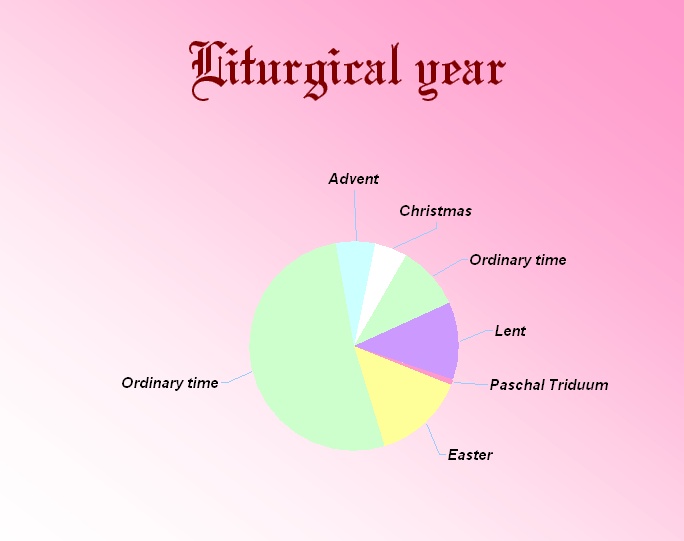
The distribution of seasons in the Christian year gives us some indication of how we might live a balanced and ordered life in Christ. A cursory analysis reveals that there are about 65 days each year given over to fasting, in Advent and Lent; about 85 years given over to feasting, in Christmas and Easter; and that broadly the rest of the year is described as ‘ordinary’ time, in which we attend to the normal rhythms of life – its needs and pleasures.

In the Charismatic Evangelical wing of the church, I have sometimes observed a temptation to live our lives as though every day were a feast, ever hoping to surf that next ecstatic wave of the Spirit’s renewing power. While this may sometimes be well and good, we often forget the Spirit’s work in the fast. (It was, after all, the Spirit who drove Jesus into his wilderness fast, and by whose power, Jesus was enabled to resist temptation.) This contributes to an unbalanced understanding of life’s order. There is in this, a correlation with the wider culture in which we live.

Speaking on the Rule of St Benedict last week in Rome, Archbishop Rowan commented on the disordered nature of modern society in relation to time:
‘In modern Europe - and the North Atlantic world - we live in a climate where both work and leisure seem to be pervasively misunderstood, where both appear regularly in inhuman and obsessive forms. Time is an undifferentiated continuum in which we either work or consume. Work follows no daily or even weekly rhythms but is a twenty-four hour business, sporadically interrupted by what is often a very hectic form of play.’
(Rowan Williams, ‘Benedict And The Future Of Europe’)

How then does this question of ordered time and living relate to the feast of St Andrew, and the readings we have heard this morning? The answer is found somewhere in the ‘Now’ and the ‘Not Yet’ of Christian life.

Andrew is often characterised as the archetypal evangelist. It is he who, according to John’s gospel, brings his brother Simon Peter to Jesus. (And since it is Peter upon whom the church is built, we can confidently sloganise ‘No pastors without the evangelists!’) In our readings today St Paul articulates the urgent cry of the evangelist: ‘How are they to believe in one of whom they have never heard? And how are they to hear without someone to proclaim him?’ We are called to take up the challenge of proclaiming Christ in the here and now of Christian life. To celebrate and proclaim in our feast that Christ has come, and that the powers of sin and death have been conclusively defeated in his death and resurrection.

But we also recognise that Christ’s rule is not yet realised completely on earth. In our Advent fast, we remember the lingering effects of our fallen nature. We resist our captivity to the ways of a fallen world, and we are renewed in our steadfast anticipation of Christ’s return.

Our Christian year concludes with the celebration of the evangelist – the one who prompts us to undertake the urgent work of proclaiming Christ’s kingdom; but it begins with the watchful, hopeful and joyful anticipation of Christ’s coming to us – both in time 2,000 years ago, and again at the end of time. Today, on the Feast of St Andrew we say to the world: ‘Jesus has come! Come and see!’ Tomorrow, as our Advent fast begins, we wait: ‘He is not yet come, but he is coming soon!’
Amen. Come, Lord Jesus.

Tuesday, November 21, 2006

Rooted, Reformed & Renewed

For a little while now, I have been trying to develop a clear articulation of my personal manifesto for the church. I continually find myself drawn to this phrase, 'Rooted, Reformed & Renewed'. Below is an attempt to put flesh on the bones of this phrase. (I wrote this in August, and have been working on amended versions since... I intend to flesh this out fully over the next few years in a book bearing the phrase as its title...)

Rooted
I believe the local church should recognise and respect its place as a part of the one, holy, catholic and apostolic Church of God. In this way, it should live in accordance with the Holy Scriptures, the Catholic Creeds, and find the pattern of its continuing life in the dominical sacraments.

Reformed
I believe the Church of Christ should be continually receptive to His voice in and through the reception of Holy Scripture. The continuing enterprise of seeking His voice in the prophetic and apostolic witness of Scripture may not be confined to the activity of the individual, but is a task for the corporate worshipping life of the local church.

Renewed
I believe that the local church should be seeking to live in step with the Holy Spirit. It must seek always to be subservient to the prophetic call of God by the Holy Spirit; the reception of the gifts of the Spirit for the service of the church and world; and must be seeking to undertake Christian discipleship in accordance with the fruits of the Spirit.

Monday, November 06, 2006

What's Your Theological Worldview?


You scored as Neo orthodox.

You are neo-orthodox. You reject the human-centredness and scepticism of liberal theology, but neither do you go to the other extreme and make the Bible the central issue for faith. You believe that Christ is God's most important revelation to humanity, and the Trinity is hugely important in your theology. The Bible is also important because it points us to the revelation of Christ. You are influenced by Karl Barth and P T Forsyth.

Neo orthodox 93%
Evangelical Holiness/Wesleyan 79%
Roman Catholic 71%
Emergent/Postmodern 68%
Charismatic/Pentecostal 54%
Reformed Evangelical 32%
Classical Liberal 25%
Modern Liberal 21%
Fundamentalist 11%

Saturday, October 21, 2006

Review of 'The God Delusion'

Dear Ridleans,

If you are at all interested in the work of Richard Dawkins, and the media
hype (and frequent C4 documentaries presented by him) that surrounds him,
you might be interested to read this review of his latest book ‘The God
Delusion’.

http://www.lrb.co.uk/v28/n20/eagl01_.html

It is written by Terry Eagleton, the Marxist-socialist literary theorist. He
is highly critical of Dawkins’ work, and it is refreshing to find such a
critique from a source other than Christian theologians (Alastair McGrath
has written extensively against Dawkins) and a reminder that we have
sympathetic and respectful supporters in what we might think unusual places
(the Marxist-socialist left).

I hope you don’t mind me emailing this link, but I’m confidant that in
ministry we will all come across people caught under Dawkins’ influence, and
will need the resources to creatively engage with their views...

By the way, Giles Fraser also wrote something shorter on broadly the same
theme in this week’s Church Times.

http://www.churchtimes.co.uk/80256FA1003E05C1/httpPublicPages/30EF4059217687
478025720B0052EE45?opendocument

Happy reading,
Graham
--
Graham Hunter
Ridley Hall
Cambridge
gh300@cam.ac.uk
www.myspace.com/grahamhunter
07711 070200

Sunday, July 23, 2006

What Is Required Of A Pastor?


‘A man must himself be cleansed, before cleansing others:
himself become wise, that he may make others wise;
become light, and then give light:
draw near to God, and so bring other near;
be hallowed, then hallow them;
be possessed of hands to lead others by the hand,
of wisdom to give advice.’

Gregory of Naziansus, Oration, 2.71

Tuesday, July 04, 2006

The PA Game

I’ve found it amusing, and also annoying, to have encountered a number of church leaders and teachers over the past year who have no idea how to use a diary. In fact, it seems to be a part of ‘making it’ as an evangelical church leader, to be able to demonstrate the importance and busyness of one’s ministry, by constantly referring me to their ‘PA’ to make meeting arrangements.

It’s not that I contest the question of whether such leaders are busy, and / or involved in important ministries – in fact I’m quite sure that both are true. However, my certainty is owed to the fact that both have or do apply to me as well, and yet I seem able (and certainly have no choice but to) use my personal diary for appointments. Most church leaders up and down the country have to manage their own diaries, and the question of employing a PA to manage their schedule on their behalf would seem quite ridiculous and unlikely.

I find it even more strange that today one such occurrence involved an exchange of emails, in which the church leader in question could simply have responded to my suggested dates, but rather directed me to his PA to make an appointment. Emailing his PA resulted in an ‘Out of office auto-reply’ informing me that his PA was out of the office for another two days – did the church leader in question know his PA was off work?? If our church leaders are this bad at ‘people business’, maybe we should be challenging the notion that a more busy pastor with a PA is necessarily a better pastor. Let’s schedule a meeting to discuss further... Contact my PA!

Tuesday, June 27, 2006

Test

This is a test to see whether I can publish to my blog from email...