I recently stumbled across two quotes from Richard Foster's modern evangelical spiritual classic 'Celebration of Discipline'. They reminded me of Christ's words to his disciples: ‘If any want to become my followers, let them deny themselves and take up their cross and follow me.' (Matt. 16:24) They seem to be a timely reminder to those of us who are about to embark on ordained ministry, and thus be in positions where we may abuse our leadership, with its authority and power.
According to Richard Foster, this is the problem:
'The obsession to demand that things go the way we want them to go is one of the great bondages in human society today.'
And the solution:
'Modern men and women find it extremely difficult to read the great devotional masters because they make such lavish use of the language of self-denial... we must underscore to ourselves that self-denial means the freedom to give way to others. It means to hold others' interests above self-interest. In this way self-denial releases us from self-pity.'
Tuesday, May 22, 2007

Friday, May 11, 2007
What Is Essential To The Church?

Worship:
Sharing in Christ’s communion with the Father through the Spirit, the Church is gathered by baptism to be built up in its corporate life through hearing the word of God, offering prayer, praise and thanksgiving, practicing mutual encouragement and enjoying Eucharistic fellowship.
Mission:
Sharing in Christ’s communion with the Father through the Spirit, the Church is sent to be with Christ in the power of the Spirit, with him in the mission entrusted to him by the Father, so that the world might come to know Christ and be reconciled to the Father in the power of the Spirit.
Adoration & Action!!
Saturday, May 05, 2007
What Is Christian Leadership?
In discussing the question of appropriate forms of leadership for the church, we are exploring the nature of Christian leadership. Is Christian leadership something similar to Christian football or Christian radio? In each of these cases, football and radio exist as discreet and definite disciplines, with their own rules, mechanics and logic. The term ‘Christian’ stands as an collective noun to describe the people who perform and participate in the discipline. Is it the same with Christian leadership? Are we simply referring to a universal discipline called ‘leadership’ which may or may not be done by Christians? Or can the term ‘Christian’ stand in an adjectival sense, in which it affects, modifies and determines the nature of that described when used in relation to the term ‘leadership’? It is my assumption in this essay that it is this latter meaning which must apply. While there may be many interesting and helpful insights regarding leadership to be learned from the wider culture in which we live, any genuine understanding and development of Christian leadership theory must be formed within the distinctive terms of the Christian community, the Church. Thus, our theories of Christian leadership must be primarily governed by the self-revelation of God given us in the person of Jesus Christ. Christian leadership therefore finds its true provenance in the Scriptural witness to Jesus Christ, and is properly nurtured and explored by the Spirit-formed community of the Church. Steven Croft, who now heads up the recently formed ‘Fresh Expressions’ team in the Church of England makes the same point:
‘Because we are Christian ministers, our understanding of the people we are called to be and the task we are called to fulfil must be securely rooted in and consonant with the Scriptures and with the understanding of the Gospel, of Jesus Christ and the Church which we find there. It is not enough simply to be pragmatic, to argue from what we think we need to be to what we should therefore become.’ (Croft 1999, p21)
It is interesting to note that this argument is made even by a person responsible for encouraging what are often perceived to be pioneering forms of church which do not necessarily conform to inherited models of church. Where some practitioners would adopt a very pragmatic approach to such a task, promoting a ‘whatever works’ mentality, Croft is keen for any new and emerging forms of church to be rooted in the deep heritage of the Church. This results in a firm rejection of allowing primacy to any categories of thought external to the Gospel-focused tradition of the Church.
‘The understanding of ministry which we develop at the beginning of the third millennium must draw on the evolving traditions of the Church and its ministry through the ages, and not simply on understandings of leadership drawn from society around us.’ (ibid.)
We should note that while this allows the Church to resist the influence of secular management theories which are, at least superficially, hierarchically conceived, it also compels us to reject the unquestioning acceptance into the Church’s ministry of contemporary secular trends towards team or collaborative forms of management, or in other words, plural leadership. Rather, all models of leadership available in the wider world must be attended to and regarded for their potential to teach us valuable lessons, and equip us for ministry in God’s Church, but must be always made subservient to the lordship of Jesus Christ, mediated to us by the Spirit, the Scriptures and the traditions of the Church.
‘Because we are Christian ministers, our understanding of the people we are called to be and the task we are called to fulfil must be securely rooted in and consonant with the Scriptures and with the understanding of the Gospel, of Jesus Christ and the Church which we find there. It is not enough simply to be pragmatic, to argue from what we think we need to be to what we should therefore become.’ (Croft 1999, p21)
It is interesting to note that this argument is made even by a person responsible for encouraging what are often perceived to be pioneering forms of church which do not necessarily conform to inherited models of church. Where some practitioners would adopt a very pragmatic approach to such a task, promoting a ‘whatever works’ mentality, Croft is keen for any new and emerging forms of church to be rooted in the deep heritage of the Church. This results in a firm rejection of allowing primacy to any categories of thought external to the Gospel-focused tradition of the Church.
‘The understanding of ministry which we develop at the beginning of the third millennium must draw on the evolving traditions of the Church and its ministry through the ages, and not simply on understandings of leadership drawn from society around us.’ (ibid.)
We should note that while this allows the Church to resist the influence of secular management theories which are, at least superficially, hierarchically conceived, it also compels us to reject the unquestioning acceptance into the Church’s ministry of contemporary secular trends towards team or collaborative forms of management, or in other words, plural leadership. Rather, all models of leadership available in the wider world must be attended to and regarded for their potential to teach us valuable lessons, and equip us for ministry in God’s Church, but must be always made subservient to the lordship of Jesus Christ, mediated to us by the Spirit, the Scriptures and the traditions of the Church.
Tuesday, December 05, 2006
'Now' and 'Not Yet'
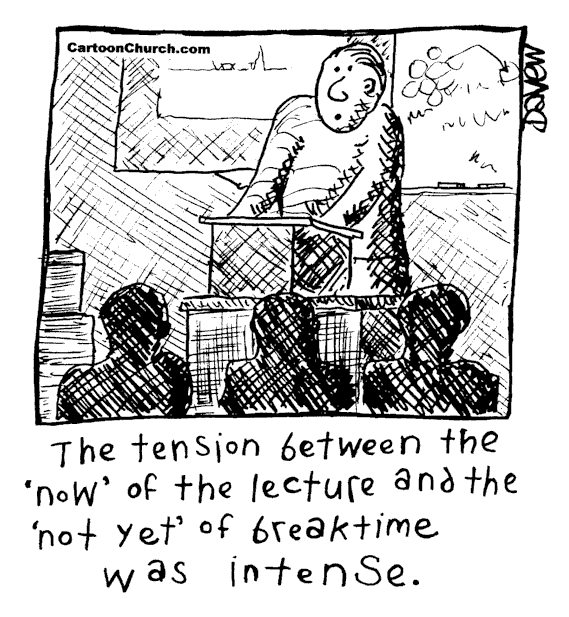
I wish I'd had this image when I gave my homily at Ridley a few days ago (see post entitled 'St Andrew's Day Homily) - this expresses how I felt during most of last year's lectures!!
A Charismatic Communion

(Below are some initial thoughts on 'Towards A Charismatic Eucharistic Theology', my broad subject area for my MA Thesis.)
A Charismatic communion is one which is truly a gift of the Holy Spirit, in that it is has its very being in the ‘gift’ness of the local expression of the body of Christ drawn into communion by the Spirit’s power. In this way, a Charismatic communion denies in its very being the work of human agency that is independent from the Spirit’s guidance in drawing together a congregation in the name of Jesus Christ. Thus, ecclesial gatherings whose common bond is expressed in sociological or demographic terms alone – be that in age, class, cultural preferences or denominational identity – are antithetical to the re-membering work of the Spirit in drawing us together in our Eucharistic feast. This is not to say that the Spirit may not work with and through these aspects of sociological identity, and thus denominational identity and worshipping preferences are not unimportant, but rather that the Spirit’s work finds its foundation on alternative ground – that of the gospel of Jesus Christ.
St Paul, by the inspiration of the Holy Spirit, articulates for us this radically alternative ground:
‘There is one body and one Spirit, just as you were called to the one hope of your calling, one Lord, one faith, one baptism, one God and Father of all, who is above all and through all and in all.’ (Ephesians 4:4-6)
‘There is no longer Jew or Greek, there is no longer slave or free, there is no longer male and female; for all of you are one in Christ Jesus.’ (Galatians 3:28)
Thus, our Spirit-filled and Spirit-given communion must first be expressed on the solid ground of the gospel. Therefore it is by our common baptism into Jesus Christ, and our submission to his Lordship that we are gathered, not upon the shifting sands of human cultural device or movement. If in our ecclesial communities we find ourselves unable to worship alongside our neighbouring Christian fellowships, and to praise God for their Spirit-giveness, then we must avoid casting judgement upon their speck and focus rather on the log in our eyes. ‘For though we are many, we are one body, because we all share in one bread.’ These words challenge us to look beyond simply the aggregation of individuals in a congregation, but to embrace a vision which encompasses all congregations in a church, and all churches in the one mystical body of Christ.
For as the scriptures direct us, all who share the Lordship of Christ by baptism and by Eucharistic celebration, and all who by the Charismatic gifts of the Spirit are being called ever onwards towards his kingdom, are in their fundamental (and ontological) nature, unified as one in Christ. Our Eucharistic celebration is not simply a recollection of events past, upon which our present identity is based, as Zwingli would have it, but rather a re-membering of Christ in the sense which is the very opposite of dismembering. That is to say that our Eucharistic celebration is an event which, as we recall Christ’s death and resurrection, we discover anew the fundamental unity that he has given to all who are baptised into him. (This, of course, could lead into fertile discussions about the relationship between baptism and communion in relation to children and infants.) We do not by our Eucharistic feast create a bond of unity between us, but recognise that bond which the Spirit has given to us, expressed in the local congregation.
We do, in the course of our celebration, repent of those things we think and do which dismember our fellowship, and this repentance is expressed in the Peace. In our repentance, and our making peace with one another in the local congregation, we recognise that this is radically different from a simple expression of ‘tolerance’ of the other, or simply a gesture of friendship. As Jesus says, ‘My peace I give to you – not as the world gives.’ The peace which comes from Jesus Christ, is one which is effective by the work of the Spirit in calling all believer to express their common bond of love by their union in Christ. Therefore, we are not simply making peace with those with whom we shake hands or hug, but are rather expressing the bond of peace which flows between all baptised believers, with whom we are knit together as one in the body of Christ. We cannot say to our neighbour in our local congregation ‘Peace be with you’ if we are unable to recognise and articulate the reality that the same peace in-dwells our relationship with our neighbouring congregations – however far removed they be from us in their cultural, worshipping style. (There is neither ‘High’ nor ‘Low’, ‘Radical’ nor ‘Traditional’, ‘Conservative’ nor ‘Catholic’ – all are one in the peace of Christ.)
(More to follow soon about eucharist and eschatology; eucharist and mission; eucharist and worship; and charismatic sacramentology...)
St Andrew’s Day Homily - Ridley Hall 2006
 I wonder how your day will start tomorrow? For most of us, it will be affected by whatever quiet day plans our staircase have, but nonetheless, I suspect that we will still go about our usual tasks of morning ablutions and breakfast – some also coping with cantankerous children, all before the dark, wet and cold journey to college.
There will be one important addition in our household, which is the opening of the first window of our Advent Calendar. Never mind that Advent fast doesn’t actually begin until Sunday, the commercial world with its candles and calendars would have us start tomorrow – and when ‘Divine’ fair-trade chocolate is involved – who am I to refuse!
Yet in the Christian calendar, today, on the eve of the Advent fast, we celebrate the feast of St Andrew the Evangelist. (To misquote Isaiah, ‘Let us feast and drink, for tomorrow we fast’!) But for those of us whose faith has been nurtured by the evangelical tradition of the church this particular form of feasting and fasting may seem unusual and irrelevant. We tend to have little experience (prior to our training at Ridley of course) of the benefits of following the liturgical calendar with its rhythm of the Christian year.
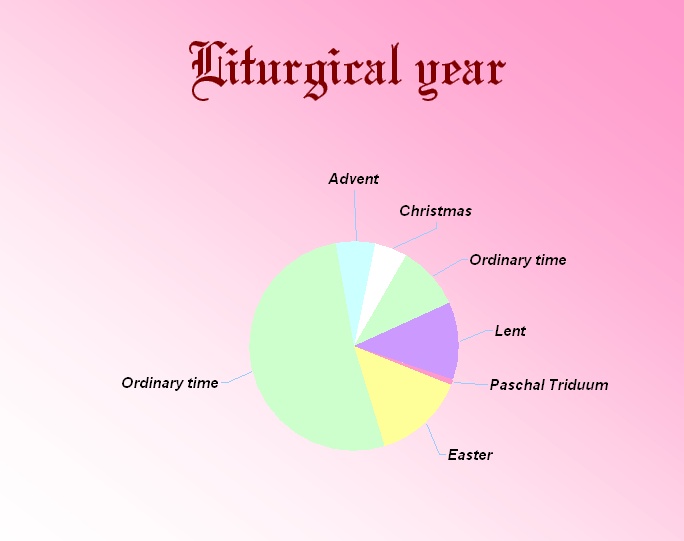
The distribution of seasons in the Christian year gives us some indication of how we might live a balanced and ordered life in Christ. A cursory analysis reveals that there are about 65 days each year given over to fasting, in Advent and Lent; about 85 years given over to feasting, in Christmas and Easter; and that broadly the rest of the year is described as ‘ordinary’ time, in which we attend to the normal rhythms of life – its needs and pleasures.
In the Charismatic Evangelical wing of the church, I have sometimes observed a temptation to live our lives as though every day were a feast, ever hoping to surf that next ecstatic wave of the Spirit’s renewing power. While this may sometimes be well and good, we often forget the Spirit’s work in the fast. (It was, after all, the Spirit who drove Jesus into his wilderness fast, and by whose power, Jesus was enabled to resist temptation.) This contributes to an unbalanced understanding of life’s order. There is in this, a correlation with the wider culture in which we live.
Speaking on the Rule of St Benedict last week in Rome, Archbishop Rowan commented on the disordered nature of modern society in relation to time:
‘In modern Europe - and the North Atlantic world - we live in a climate where both work and leisure seem to be pervasively misunderstood, where both appear regularly in inhuman and obsessive forms. Time is an undifferentiated continuum in which we either work or consume. Work follows no daily or even weekly rhythms but is a twenty-four hour business, sporadically interrupted by what is often a very hectic form of play.’
(Rowan Williams, ‘Benedict And The Future Of Europe’)
How then does this question of ordered time and living relate to the feast of St Andrew, and the readings we have heard this morning? The answer is found somewhere in the ‘Now’ and the ‘Not Yet’ of Christian life.
Andrew is often characterised as the archetypal evangelist. It is he who, according to John’s gospel, brings his brother Simon Peter to Jesus. (And since it is Peter upon whom the church is built, we can confidently sloganise ‘No pastors without the evangelists!’) In our readings today St Paul articulates the urgent cry of the evangelist: ‘How are they to believe in one of whom they have never heard? And how are they to hear without someone to proclaim him?’ We are called to take up the challenge of proclaiming Christ in the here and now of Christian life. To celebrate and proclaim in our feast that Christ has come, and that the powers of sin and death have been conclusively defeated in his death and resurrection.
But we also recognise that Christ’s rule is not yet realised completely on earth. In our Advent fast, we remember the lingering effects of our fallen nature. We resist our captivity to the ways of a fallen world, and we are renewed in our steadfast anticipation of Christ’s return.
Our Christian year concludes with the celebration of the evangelist – the one who prompts us to undertake the urgent work of proclaiming Christ’s kingdom; but it begins with the watchful, hopeful and joyful anticipation of Christ’s coming to us – both in time 2,000 years ago, and again at the end of time. Today, on the Feast of St Andrew we say to the world: ‘Jesus has come! Come and see!’ Tomorrow, as our Advent fast begins, we wait: ‘He is not yet come, but he is coming soon!’
Amen. Come, Lord Jesus.
Tuesday, November 21, 2006
Rooted, Reformed & Renewed
For a little while now, I have been trying to develop a clear articulation of my personal manifesto for the church. I continually find myself drawn to this phrase, 'Rooted, Reformed & Renewed'. Below is an attempt to put flesh on the bones of this phrase. (I wrote this in August, and have been working on amended versions since... I intend to flesh this out fully over the next few years in a book bearing the phrase as its title...)
Rooted
I believe the local church should recognise and respect its place as a part of the one, holy, catholic and apostolic Church of God. In this way, it should live in accordance with the Holy Scriptures, the Catholic Creeds, and find the pattern of its continuing life in the dominical sacraments.
Reformed
I believe the Church of Christ should be continually receptive to His voice in and through the reception of Holy Scripture. The continuing enterprise of seeking His voice in the prophetic and apostolic witness of Scripture may not be confined to the activity of the individual, but is a task for the corporate worshipping life of the local church.
Renewed
I believe that the local church should be seeking to live in step with the Holy Spirit. It must seek always to be subservient to the prophetic call of God by the Holy Spirit; the reception of the gifts of the Spirit for the service of the church and world; and must be seeking to undertake Christian discipleship in accordance with the fruits of the Spirit.
Rooted
I believe the local church should recognise and respect its place as a part of the one, holy, catholic and apostolic Church of God. In this way, it should live in accordance with the Holy Scriptures, the Catholic Creeds, and find the pattern of its continuing life in the dominical sacraments.
Reformed
I believe the Church of Christ should be continually receptive to His voice in and through the reception of Holy Scripture. The continuing enterprise of seeking His voice in the prophetic and apostolic witness of Scripture may not be confined to the activity of the individual, but is a task for the corporate worshipping life of the local church.
Renewed
I believe that the local church should be seeking to live in step with the Holy Spirit. It must seek always to be subservient to the prophetic call of God by the Holy Spirit; the reception of the gifts of the Spirit for the service of the church and world; and must be seeking to undertake Christian discipleship in accordance with the fruits of the Spirit.
Subscribe to:
Posts (Atom)